The 2025 NHS long-term plan Fit for the Future focuses on moving from sickness to prevention. One of Fit for the Future’s aims is to empower citizens to make the healthiest choices. There will be a new health reward scheme to motivate healthier lifestyles. The plan has a commitment to work with the Great Run Company to get millions of people to move more regularly. This is an ideal time to promote the exciting innovations in inclusive bike engineering. There truly is a bike for everyone, if only they knew it.
My journey to inclusive bikes
Ten years ago, I brought my adult kick scooter on a bus. An older passenger looked at the kick scooter with envious eyes and asked me what it was like to ride it. She explained that she had balance issues and could no longer ride a bike. I said that riding the kick scooter was fine for short distances, but could be quite wearing on the wrists from all the bumps from rough surfaces. (I did not have pneumatic tires on that kick scooter, which would have made riding it more comfortable.)
Although there are some adult riders of kick scooters in my home city of Cambridge, most other reactions I encounter are from people bemused at seeing an adult riding a ‘childish’ form of transport. (This was before e-scooter hire trials began.) My private reaction to a senior citizen contemplating riding a kick scooter was also ageist. I was so surprised that I did not make the obvious suggestion that she try a tricycle instead of a kick scooter. Now I wonder if she’s happily riding around Cambridge on an adult balance bike.
Can inclusive bikes help me improve my healthy life expectancy?
As I am at midlife, I often think about what I need to do to have a healthy retirement. Keeping active is an important part of this. I am a carer for a relative who does not do any exercise. The person that I care for is deconditioned to the extent that they find it difficult to stand up and mobilise. There are inclusive bike models that have two seats side by side, which allow an able body person to pilot someone with disabilities or dementia, which would be ideal for me to transport my relative. (Such as the vanRaam side-by-side tandem bike in the image.)
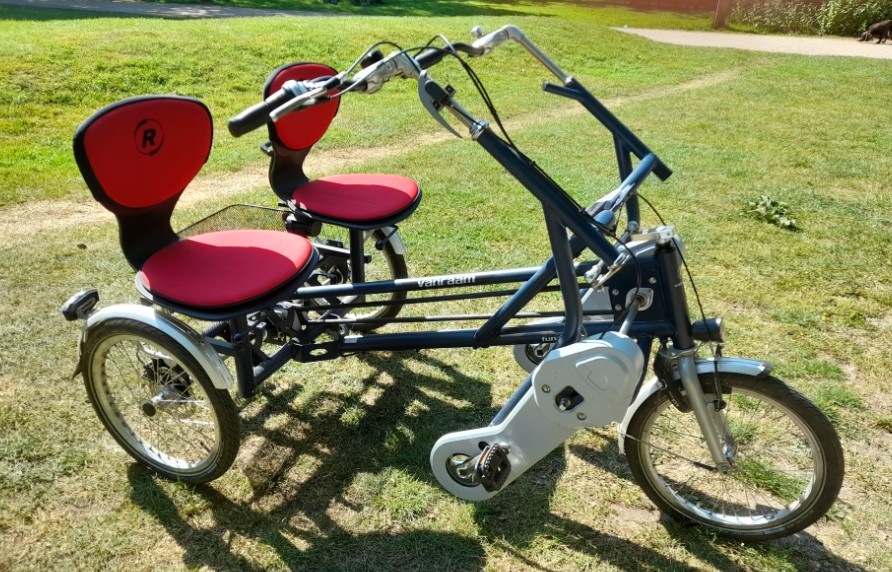
There is an inclusive bike hire scheme near where my relative lives, which includes an adaptive bike with a platform for a wheelchair in front. (This is the Strawberry Line Cycle Project.) However, my relative is so frightened of falling that they have developed agoraphobia, and rarely venture outside. It can also be difficult to coax them into a taxi. They live in a notorious bottleneck for road traffic that is not inclusive bike-friendly. Perhaps when the local bypass is built, the roads will be calm enough for me to safely bike my relative around in a side-by-side tandem bike instead of getting taxis. Moreover, this will help my relative get vitamin D naturally rather than via a tablet.
Why I’m beginning to find riding a traditional bike uncomfortable
Like 50% of men my age, I have an enlarged prostate, and this is why I am looking into adaptive bikes. I find it uncomfortable to ride a traditional bike seat, and now use a padded cycle seat and cycle shorts to relieve pressure on the prostate. Riding a bike is my preferred choice of exercise. However, I do not want to wear cycling shorts for my short bike ride to work. So, I am looking at getting a semi-recumbent trike for when I do long distance bike rides, as the seating is more comfortable with less pressure on the prostate.
Kevin Mahoney