What you can do to make Inclusive Cycles normative
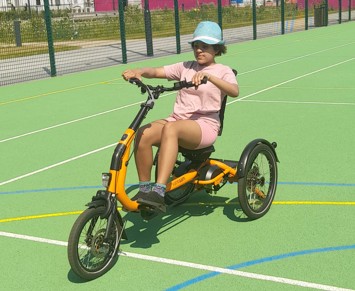
Wheels for Wellbeing (WfW) is a UK charity that campaigns for Disabled people to enjoy the benefits of Inclusive cycles. They regularly produce a comprehensive Guide to Inclusive Cycling. In the 5th edition of the guide, they state that it is more inclusive to use the neutral term “Cycles” instead of “Bikes”. This is because “bikes” refers to “bicycles”, which are two-wheeled and excludes tricycles/handcycles. WfW do not use the term “adaptive” as this implies that cycles need to be adapted for Disabled people. Indeed, cycles like tandems and trikes were not designed for Disabled people.
I took a wrong turn in the first part of my journey for Inclusive Cycles
Eagle-eyed observers will note that I use the term “adaptive bikes” in the URL for this website. At the start of my journey, I was not aware of WfW’s “Language and Ethos” guidance. I haven’t changed the URL though, as I think it’s important to acknowledge the language that laypeople use for inclusive cycles. I want this website to be found by laypeople like myself at the start of their inclusive cycle journeys.
Where I don’t follow the WfW path for Inclusive Cycles
Wheels for Wellbeing’s guidance is to use the term “standard cycle” for a bicycle. They also prefer to use “non-standard cycle” for all other bike models, such as cargo cycles and handcycles. However, I find the these terms to be quite clunky, so I don’t use them. I prefer to use the term “Inclusive Cycles” when writing about cycles for disabled people. This is a term that WfW use also. In addition, “Inclusive Cycling” is a term that various British charities use to promote Disabled cycling. Indeed, you may not find such local organizations if you searched for “adaptive bikes” online instead.
WfW is a campaigning organization, and spell “Disabled” with a capital “D” to highlight inequitable cycling provision.
Inclusive Cycling has a broader definition internationally
My perception is that internationally, “inclusive cycling” has a broader definition than in the UK. Certainly in the podcast sphere there is the North American organisation All Bodies on Bikes, which focuses on creating a body size inclusive community. They campaign to get better cycling products for cyclists of all body sizes.
Why do more women than men ride tricycles?
I consider tricycles to be inclusive cycles. In recent years, I have seen more women than men riding tricycles in Cambridge. I Googled “Why do more women than men ride tricycles?” One of the main reasons suggested in an Cycling UK article by Alix Stredwick is that women do more “escort trips”. Women are more likely than men to take children to school via cycle. However, most of the search engine results went beyond my tricycle question. The results highlighted that significantly fewer women cycle than men in the UK.
It is not just Disabled People that have barriers to cycling: Women
A 2026 Urban Cycling Institute article by Seren Rayment states that more women than men cycle in Amsterdam. However, only 26% of cyclists in London are women despite recent investment in cycling infrastructure. Rayment reports that the use of helmets may increase the perception of risk. This puts off women, who are more risk adverse than men (according to a 2016 study by Rachel Aldred et al.)
Not all cyclists are “MAMILs”
The common representation of a cyclist as a “middle-aged white man in Lycra” (MAMIL) increases women’s perceptions that they do not fit the image of a cyclist. Whereas in Amsterdam, cyclists wear ordinary clothes without the requirement of a helmet. (I’m not suggesting that cyclists shouldn’t wear helmets. However, if we do want to encourage more cyclists, then we do need to consider this.)
Women cycling in London have also reported that they are often patronised by drivers. They feel more vulnerable cycling at night than their Dutch counterparts.
People from Ethnic Minority groups also face barriers to cycling
A 2020 report from Walk Wheel Cycle Trust (formerly Sustrans) stated that 74% of people from ethic minority groups in the towns and cities that they reviewed don’t own a bike. This was twice the number of white people that didn’t own a bike in these locations. There are a number of barriers, such as the cost of a cycle, and lack of secure storage. The report suggested the extension of the cycle to work scheme to lower incomes would help.
Hostility towards cycle lanes
In the “Cycling provision separated from motor traffic” report by Aldred et al. 2016, they found that “women reported stronger preferences than men for greater separation from motor traffic.” However, in the age of social media, opposition against cycle lane provision is highly vocal and often aggressive in tone.
Potholes are also a barrier to Inclusive Cyles
After years of austerity, Britain’s roads are full of potholes. This increases the risk of damage to cars. Potholes are also a danger to cyclists. (Why are the roads so bad right now? looks at potholes from Cambridgeshire County Council’s perspective.) When councils build new cycle lanes, some motorists resent this, arguing that this money should be spent on the roads. Motorists pay road tax after all. (This is the actually the Vehicle Excise duty or car tax. Motorists must pay this tax to keep their cars on the public road.)
Road Rage as a barrier to Inclusive Cycles
Sadly, 24% of disabled cyclists in Wheels for Wellbeing’s 2021 survey reported “Public hostility, harassment and abuse” as a barrier to cycling.
The below is a quote from WfW’s 5th Edition Guide to Inclusive Cycling:
“As much as I am concerned about road rage as any other cycle user, my concerns
are amplified because of how I’m racialised and because of the fact that I’m disabled.
I have lost count of the number of times that I have been accosted by road rage, coupled with racism and disableism as well.”
What should we prioritise when there are insufficient public funds?
There was a recent article in my local newspaper in which a local resident attacked the building of England’s first Cycle Street as a “vanity project”. This is because he was struggling to wheel his mother in her wheelchair due to all the potholes on the pavement. His argument was that you should attend to basic provision before spending funds on projects like this. Although there will be many disabled cyclists using the Cycle Street, the resident is right to expect to wheel his mother safely. From the Social Model of Disability perspective, the potholes on the pavement are disabling for his mother.
Austerity impacted Shopmobility in Cambridge
Local government is a thankless task in an age of austerity. For instance, Cambridge City Council introduced a charge for users of the Shopmobility scheme in 2018 to help balance the books. They had to reverse this charge when demand dropped substantially.
The Politicisation of Inclusivity
Providing equitable and inclusive provision was, until recently, politically neutral. Unfortunately, “inclusivity” is coming under attack from populists on the right of the political spectrum. They attack DEI (Diversity, Equity and Inclusion) programmes, claiming that they limit meritocracy, impede free speech, and lead to reverse discrimination. Some right-wingers declaim DEI initiatives as “woke” and a waste of money. Such tensions may well be due to rising tensions globally from the climate emergency. One UK political party has declaimed measures to reduce carbon emissions as “Net stupid zero”.
The Social Model of Disability versus the Medical Model
Wheels for Wellbeing subscribes to the Social Model of Disability, where people are not disabled by their bodies but by the lack of equitable provision. However, the Medical Model of Disability focuses on interventions such as medical cures. This led to a rather old-fashioned view of disability as promoted by various charities that the Victorians established.
In the Social Model of Disability, people find that they are Disabled by inaccessible cycling infrastructure. The higher cost of inclusive cycles is another disabling factor.
The Sphinx’s Riddle: Disability is not static
However, I have a different approach from Wheels for Wellbeing. I include aspects of the Medical Model of Disability. The main reason why I am interested in inclusive cycles is because I want to increase my healthy life expectancy. I certainly want to have a healthier old age than the relative I care for.
My relative has made some unhealthy lifestyle choices. They have an addiction that has greatly contributed to their disability. They do not mobilise much for fear of falling. This means that they have deconditioned (their muscles are weaker), and are therefore more likely to fall.
Unless I die prematurely, I cannot escape the riddle that the Sphinx gave to Oedipus. “What walks on four feet in the morning, two feet in the afternoon, and three feet in the evening?” However, I do want to improve my healthy life expectancy by engaging in active travel as long as possible.
Making Inclusive Cycles more visual
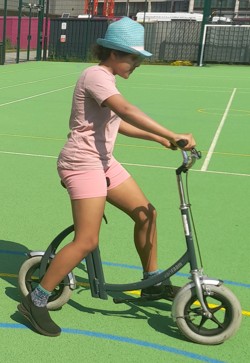
So, I am looking for an inclusive cycle that will meet both my current and future needs. Hopefully, by doing so, I will help change perceptions of inclusive cycles by riding it on my commute. I want to make inclusive cycles the norm rather than the exception. To increase the visual representation of disabled cyclists, WfW have created a free photobank of disabled cyclist photos. I have signed up to this photobank, although I mostly use my own photos on this website.
Kevin Mahoney
[…] mentioned in a previous blog, women are more risk averse and may not have wanted to cycle in this lane that is only separated by traffic by a white dotted […]