How you can make hospitals accessible to Disabled cyclists
This is a case study from Spring 2026 when it was more difficult for disabled cyclists to travel to Cambridge University Hospitals (CUH). There were several roadworks leading to increased traffic congestion. The County Council also closed off local cycle paths to install safety fencing, following a HMRC ruling.
Usually there aren’t any disruptions to cycling to the Cambridge Biomedical Campus. When roadworks are necessary, I want to demonstrate that there are better ways of managing them for disabled cyclists. I hope that the advice here will also be useful for other hospital sites in the UK.
But we don’t see any Disabled cyclists on site!
You don’t tend to see any adaptive bikes whizzing around the hospitals. (Although I prefer to use the term “inclusive bikes”). However, according to Wheels for Wellbeing’s Guide to Inclusive Cycling, there are 16 million people in the UK with a disability. This is 24% of the population. One in four of us has a disability. The source of this data is the 2025 Department for Work and Pensions’ Family Resources Survey. As the survey reports:
“The term “disability” follows the core definition of disability in the Equality Act 2010 which states that a person is considered to have a disability if they have a physical or mental impairment that has ‘substantial’ and ‘long term’ negative effects on their ability to do normal daily activities.”
Disabled Cyclists may have hidden disabilities
According to the 2021 Wheels for Wellbeing (WfW) survey, 64% of disabled people found cycling easier than walking. 60% of disabled people in the survey used a standard two-wheeled bike. Two-wheeled bikes are cheap and easy to store, unlike inclusive cycles.
So, many of the cyclists we already see on campus have a disability. We just do not know what their disability is.
For some disabled people, this invisibility of their disability is highly liberating.
The challenges for Disabled Cyclists using two-wheeled bikes
If a Disabled cyclist is using a bike as a mobility aid, people may challenge them for cycling in a pedestrian space. Wheels for Wellbeing has proposed legislation that would allow Disabled people to cycle in public spaces at walking pace. This would involve Disabled cyclists using a form of self-certification.
Disabled cyclists face many physical barriers
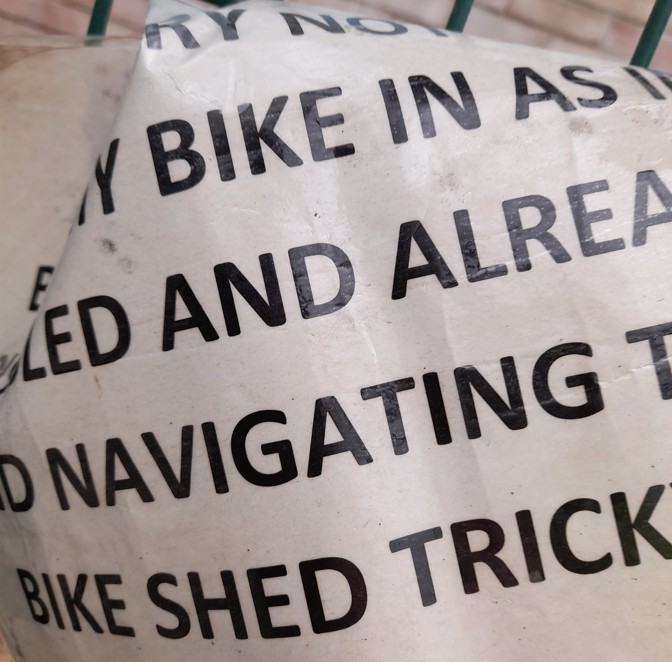
The featured image of this blog post is a sign that a disabled worker at the hospitals has been using in the cycle sheds. Their purpose in creating this sign was to ask other cyclists not to block access to their cycle. The Disabled cyclist wrote that they found the door to the cycle shed to be very heavy. This is something that I agree with, as I’ve also struggled with the heavy cycle shed doors. Especially when I was transporting my child to the hospital nursery using a bike trailer.
Our signage is not hospitable to Disabled cyclists
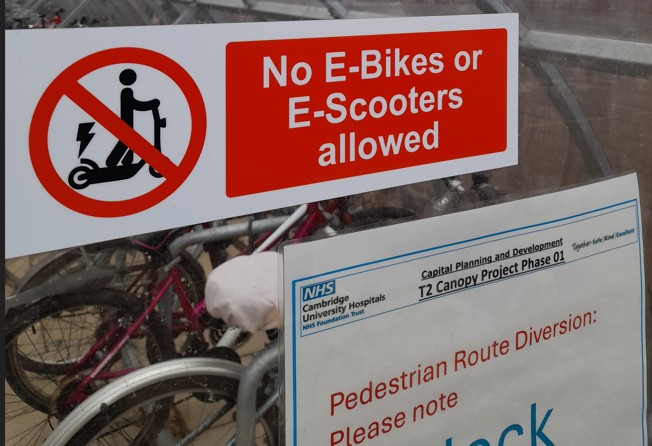
I have complained before about the above sign banning e-bikes from a public cycle shed on the hospital grounds. The CUH Fire Safety team posted these signs following an increasing number of lithium-ion battery fires in the UK. Typically these devastating fires ignite in households when their owners charge the batteries overnight. However, I have argued that we can reduce these fires by better educating owners about the risks. Indeed, it would not be appropriate for anyone to charge an e-bike battery in the hospital due to the fire risk.
Some Disabled cyclists use e-bikes with lithium-ion batteries
Wheels for Wellbeing advocate that the government should better regulate the retailers of unsafe e-bike batteries:
“These changes could reduce risk of battery fires without unreasonably restricting use of
safe, environmentally friendly, efficient e-assist and e-powered mobility aids that
Disabled people rely on.”
Cars also represent a fire risk
Subsequent to the use of the above sign, there were two car fires on the hospital site. One of these fires caused significant damage to one of the hospital car parks. However, there was no ban on cars on the hospital site, as this would have impacted operations significantly. (As many hospital workers have to commute in by car due to high property prices in Cambridge.)
It is highly disproportionate to ban a legal form of transport such as e-bikes from some hospital cycle sheds. I am fine with the banning of private e-scooters from the hospital cycle sheds, since they are there illegally, as owners can only ride them on private land
The Equality Act (2010) protects Disabled Cyclists from Discrimination
I have seen several patients using e-bikes to travel to the hospitals. Although the Fire Safety team say that there are other places to safely park e-bikes on the hospital site, they do not specify where they are. If the above sign discouraged a disabled patient from travelling to the hospital by e-bike, then the sign may be a breach of the Equality Act (2010). There is no reference on the sign as to where equitable cycling parking spaces are located, or if cyclists are even allowed to park e-bikes elsewhere at the hospital.
“Reasonable Adjustments” versus “Workplace Adjustments”
The Equality Act (2010) states that organisations must provide “reasonable adjustments” to avoid discriminating against Disabled people. The Cambridge University Hospitals’ (CUH) website states that:
“Everyone with a disability, health condition, or neurodiversity who comes to our hospitals, whether as a patient, staff member, or visitor, should have as positive an experience as anyone else.”
However, the website goes on to say:
“The government calls changes to the built environment, ways of working, or how we communicate “reasonable adjustments.” Here, we call them “workplace adjustments.”
Some disabled patients and visitors could feel excluded by CUH using the term “workplace adjustments” instead of “reasonable adjustments”. So, I advise CUH to revert to the Equality Act (2010)’s “reasonable adjustments” terminology, as the hospital is clearly not the “workplace” of disabled patients and visitors.
The Public Sector Equality Duty (PSED)
There is also the Public Sector Equality Duty (PSED), in which public bodies should promote the equality and inclusion of Disabled people. According to WfW, public bodies often do Equality Impact Assessments (EqIA) to show that they have promoted the equality and inclusion of Disabled people. Public bodies should make these EqIAs available to the public.
Highway Maintenance signs on the Cambridge Biomedical Campus are not hospitable to Disabled Cyclists
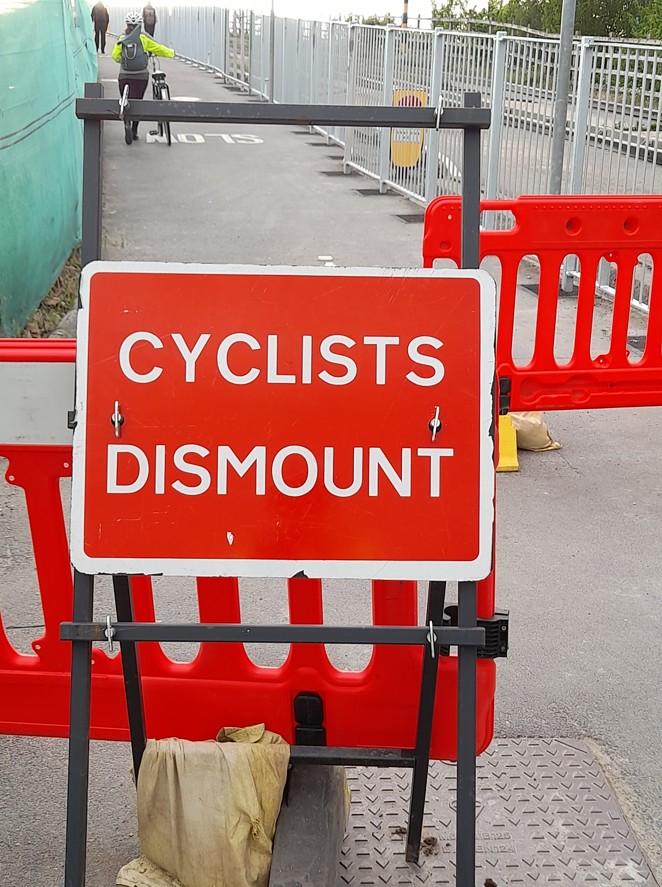
The above sign asking cyclists to dismount is on the busway bridge next to Cambridge South railway station. When providing accessible provision for works, Wheels for Wellbeing advise using an updated sign which reads “Cyclists dismount unless a mobility aid“. This takes into account that, as above, many Disabled people use cycles as mobility aids. This means that they cannot easily get off their cycle and walk instead.
Cargo Cycles are not designed to be pushed uphill
In the context of Cambridge, the above sign is also disabling for parents escorting children to school via cargo cycles. As you may see from the picture, this sign is on a bridge. Cargo cycles without an electrical assist “walk mode” are not designed to be pushed uphill by the parent/carer. (Especially not with the kids inside!) Given that cargo bikes are so prevalent in Cambridge, the above sign is rather tone deaf.
Please do not ignore “No overtaking of cyclists” signs
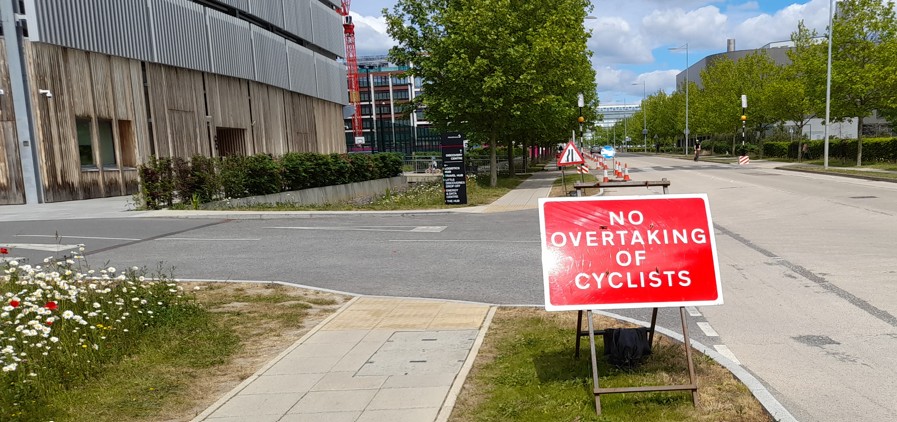
As the same time as the “Cyclists dismount” sign was in situ, the above sign was also on the same road, Francis Crick Avenue. It is a bit better in that it does not ask cyclists to dismount while the cycle lane is closed for works. However, it does not really take into account the psychology of road users.
As mentioned in a previous blog, women are more risk averse and may not have wanted to cycle in this lane that is only separated by traffic by a white dotted line. I observed parents with children cycling within the closed off cycle lane because they felt safer behind the cones. Perhaps the roadworkers could have opened the cycle lane during rush hour? It never helps when it looks like no works are happening.
Walk This Way!
I obeyed the sign and cycled in the road. However, several motorists ignored the sign and overtook me. This would likely have put off more risk adverse cyclists from taking this route. It didn’t help that there was also a cycle lane closed off on the adjoining Dame Mary Archer Way, which led to increased car traffic congestion.
There were also buses parked on the other side of the road to take campus workers to and from Trumpington Park and Ride, and so less room to safely overtake cycles. (Due to the safety fence work closing off the walk/wheel/cycle busway path leading to Trumpington Park and Ride.)
Wheels for Wellbeing advise that:
“Where keeping a route open is impossible, the shortest possible alternative
accessible route for walking/wheeling and for cycling must be provided and clearly
signposted, and the usual route re-opened as rapidly as possible.”
There was a sign on the other side of the road stating that pavement was to be shared access. However, the only route away from traffic pollution would have meant a big detour for a wheelchair user down the permissive path that runs parallel to Dame Mary Archer Way.
Everything Everywhere All at Once!
At one point recently, the busway bridge was closed to pedestrians/cyclists/wheelers at the same time as cycle lanes were closed on Francis Crick Avenue and Dame Mary Archer Way.
Bus companies and motorists often complain that there are too many roadworks going on in Cambridge at the same time.
Indeed, Cllr Alex Beckett, Chair of the Highways and Transport Committee at Cambridgeshire County Council, has a written a SubStack called Why are there so many roadworks?
Key takeaways from this article are:
· Most roadworks aren’t done by the council, but they do everything they legally can to manage and reduce disruption.
· The council refuses and modifies permits, monitoring works in real-time, and issues fines when companies get it wrong.
One of the things the council can do is to ask companies to do works at off-peak hours. As I suggested above, it would have helped with the recent works on Francis Crick Avenue if the cycle lane had only been closed outside of peak hours.
I will send my blog post to Cllr Alex Beckett and ask for feedback on the highways issues that I have raised.
No Room at the Inn for an Inclusive Cycles Project!
Bikeworks (a Community Interest Company (CIC) based in London), is wanting to run a pilot with the CUH physiotherapy team. This pilot aims to show how inclusive cycles can help patients rehabilitate. However, despite a focus on prevention rather than cure in the NHS long-term plan “Fit for the Future”, there is apparently no space on the Cambridge Biomedical Campus where Bikeworks can securely lock their cycles up at night. Their inclusive bikes are expensive, so they do need to be parked somewhere secure when they are not being used.
As I hope to show elsewhere on this website, there are several companies manufacturing inclusive cycles with innovative engineering techniques. There’s never been a better time to find out which cycle suits you best. This may be a big factor why we don’t see inclusive cycles on campus, because we’re not showing patients what the possibilities are.
Local Services Closing for people with Learning Disabilities and Mental Health Challenges
With the recent news that Cambridgeshire and Peterborough NHS Foundation Trust (CPFT) is not going to extend its contract with Darwin Nurseries in 2028, it would seem that local Trusts are making difficult decisions due to limited finances. In terms of the Centre for Sustainable Healthcare’s SuSQI framework, CPFT have decided that the financial impact outweighs the health and social outcomes for the people with learning disabilities and mental health challenges that volunteer at Darwin Nurseries.
This reminds that people with learning disabilities from the Papworth Trust used to do bike repairs at CUH.
Cambridge South Railway Station opening 28th June 2026
It is likely that some of the roadworks on the campus were related to the imminent opening of the Cambridge South Railway Station. There will be 1,000 cycle spaces at the station. The plan is for passengers to travel to Cambridge South via public transport or active travel, as there will no car park there beyond a few spaces for drop-offs.
While all of the combined roadworks caused disruption to Disabled cyclists, they may be able to take advantage of this increased transport infrastructure when the station opens.
Indeed, all the works mentioned above are now complete, so access for Disabled cyclists to the hospitals is back to normal.
Kevin Mahoney
[…] did a case study on the impact of the roadworks and the path closure. Councils have some control on the timing of […]
One of things would be to have information on Connect about available financial help for people who would like to purchase bicycle, etc. Pre-tax affordable loan, links to companies which support the scheme.
I also agree that banning e-scooters and e-bikes is not very well thought through idea. Perhaps it would be worth considering fireproof containers where e-scooters & bikes could be safely parked?… Or something similar.
Ah yes, I’m planning to do a review of the cycle to work loan schemes available on our intranet in a blog post.
I’ve been thinking about putting in an ACT funding bid for some e-bike sheds at the front of the hospital where there are poor quality cycle hoops. While these wouldn’t be fire proof, they’d be sufficient distance away from the main hospital building to reduce the fears of the Fire Safety team, while hopefully still be close enough to be useful for Disabled patients/visitors/staff.